Most first products never ship. Not because the idea is bad. Because it's too big. A twelve-module course, a membership, a programme with bonuses. It sits in a Google Doc for six months, “nearly ready”, while nobody buys anything.
This is the fix. Four steps that make your first product small enough to finish this week, and specific enough that someone actually pays for it.
Big isn’t valuable. Specific is.
We assume value means size. More modules, more hours, more pages, so more value. It’s backwards.
It goes the same way every time. First the plan: you map the whole course, and it feels like progress. It’s a table of contents. Then the stall: it’s too big to finish and too vague to sell. Who’s it for? “Anyone who wants to get better at marketing.” That’s nobody.
Then there’s the door: one answer to one question, with a price on it. That sells, because the buyer already knows they have the question.
Three illusions that keep it growing
Complete. “It has to cover everything.” It doesn’t. The buyer has one question. A syllabus answers fifty they never asked.
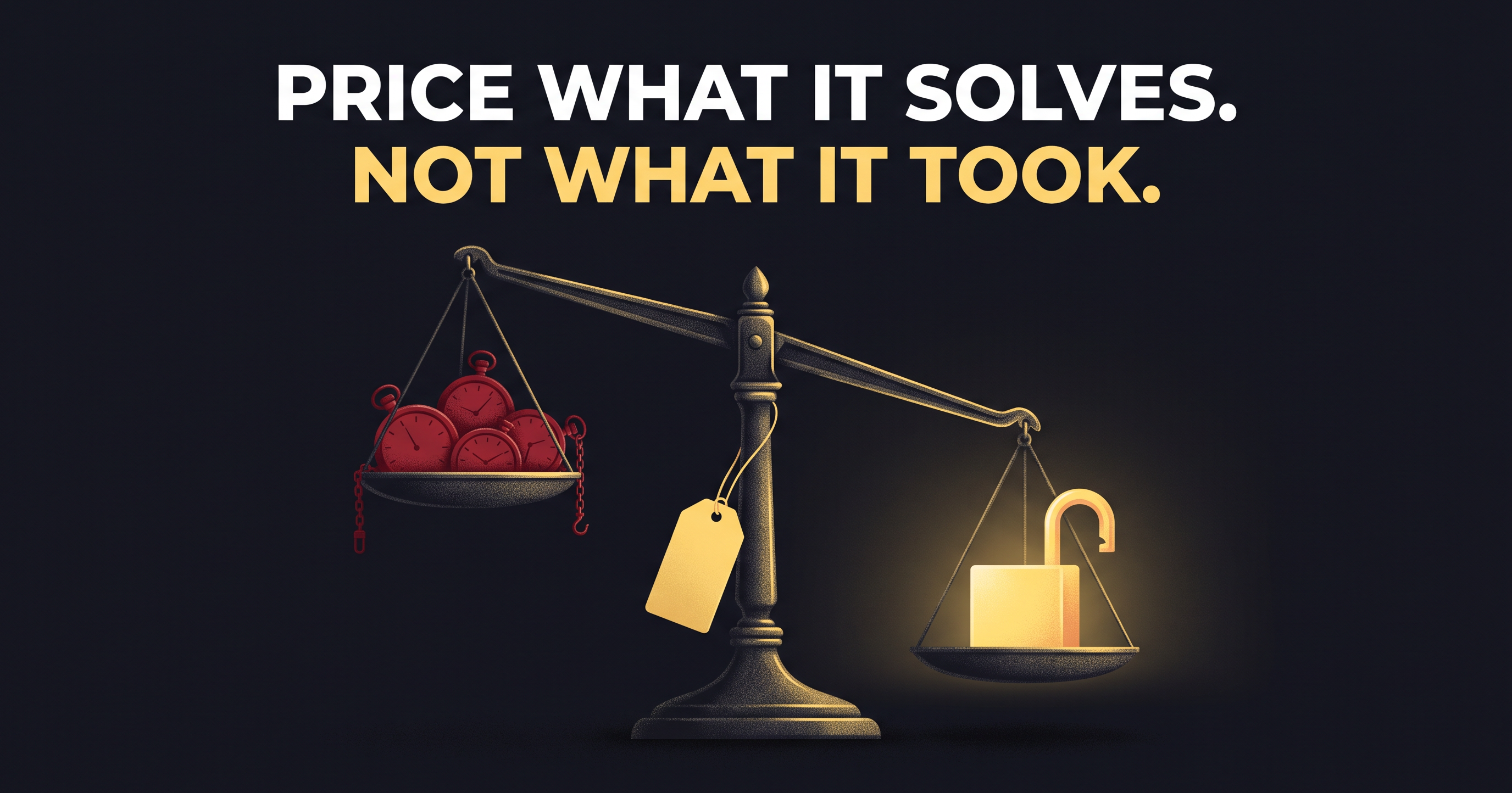
Worth. “Small means cheap.” It doesn’t. Price follows the problem, not the page count. One page that fixes an expensive problem is worth more than twelve modules on a vague one.
Later. “I’ll do the small one after the big one.” Backwards. The small one tells you what the big one should be.
All three make the product bigger. None of them make it sell.
What you’re usually told vs what works first
Search how to create your first digital product and the answers describe the same building. Build a full course. Launch a membership. Grow an audience first. Go high-ticket. Ship it when it’s complete.
None of that is wrong eventually. It’s just not first. All of it assumes you have months, and trust you haven’t earned yet.
What works first is smaller on every axis: one question they already ask, one answer written once, one page with one price, sold to someone who already asked. This week.
Step 01: The Question
Find the question you’ve answered ten times.
Go back through your DMs, your client calls, your emails. What do people ask you that you could answer in your sleep? That isn’t a chore. It’s market research you’ve already done. They’ve told you what to sell.
DMs and calls are where people ask the real version. Comments get the polite version.
The test: is there a problem in it? “How do I…” or “What do I do when…” is a door. A single word, like “marketing” or “fitness”, is a topic. A topic is a course. A question is a door.
Step 02: The Answer
Write the answer once, the version you’d give a friend over a coffee. Not the textbook version. The “here’s what you actually do” version.
A checklist or a template is usually enough. They’re the fastest to make and the easiest to use without you there.
The rule: if it takes more than a week to make, it’s not the smallest door. Cut it in half and ask again.
You’ve probably already written most of it, in an email you keep forwarding or a doc you send to every new client. It isn’t missing. It just hasn’t been separated out and given a price.
Step 03: The Door
One page. One price. One button.
The page holds four things:
- The question, as the headline, in their words
- What the answer is, in a line
- The price
- One button that takes money
No menu. No “about me”. No five other products. Every extra destination is a way off the page.
And the button takes payment. Not “DM me”, not “book a call”. If the sale needs you, it’s not a product. It’s an appointment.
Price the problem, not the page count. Small and cheap are not the same word.
Step 04: The Pound
Sell it once, this week, to someone who already asked.
Who asked you that question in the last month? That’s your first buyer list. You’re not selling to strangers. You’re replying to people who raised their hand. Send them the page, not a pitch: “You asked me about this. I wrote it up properly. Here it is.”
One sale proves the door works. It also does something more useful: it tells you what they ask next. Their next question is your next door. That’s how the big product gets built, one small door at a time, from questions real buyers asked.
Your sentence
Finish this before you close the tab:
The question is _. The answer is a _. First sale by ___.
The last blank is a day. Not “soon”. Soon is how the big product sat in draft for six months.
How to start marketing online (before you build a website)
The most common version of “where do I start?” is a website. People ask how to build one because it feels like the first step. It isn’t.
I know because it was my mistake. I built websites before I knew the first thing about marketing. Nice-looking sites, and nobody came. I had the building and no strategy.
Most of the confusion comes from treating three different jobs as one:
- Advertising gets you seen. Paying for attention: ads, boosts, sponsored posts.
- Marketing gets you wanted. The right person seeing their problem, solved, before you ask for anything.
- Sales gets you paid. The moment they decide.
Most people buy the first, skip the second, and wonder why the third feels like pushing a boulder. A website is none of the three. It’s just where they happen.
Get the middle one right and the sale becomes the easy part. That’s why the smallest door works: the question is the marketing. They already want the answer before they reach the page.
That’s also exactly how I’m applying it to my own business this week. When I asked my list what they wanted from me, the real question underneath was how do I start marketing online? So my smallest door is a strategy guide with the advertising/marketing/sales section at the front, not another website. And the next question its buyers ask, traffic, tells me what the second door should be.
Why it works
In Structural Ownership Integration™, this is Conversion Logic Compression: the shorter the path from interest to decision, the less leaks out. A big product is a long path, trust me for twelve modules. A small door is one step: you’ve got the question, here’s the answer.
The big product takes months, sells on trust you haven’t earned, and tells you nothing until it’s done. The smallest door takes a day, sells on a question someone already asked, and tells you what to build next.
Ask the Litmus Test: If the funnel disappeared tomorrow, what do you still own? With a small door the answer is the buyer, and their next question.
Nobody buys a course. They buy the answer to their question. The big product isn’t cancelled. The door tells you what goes in it.