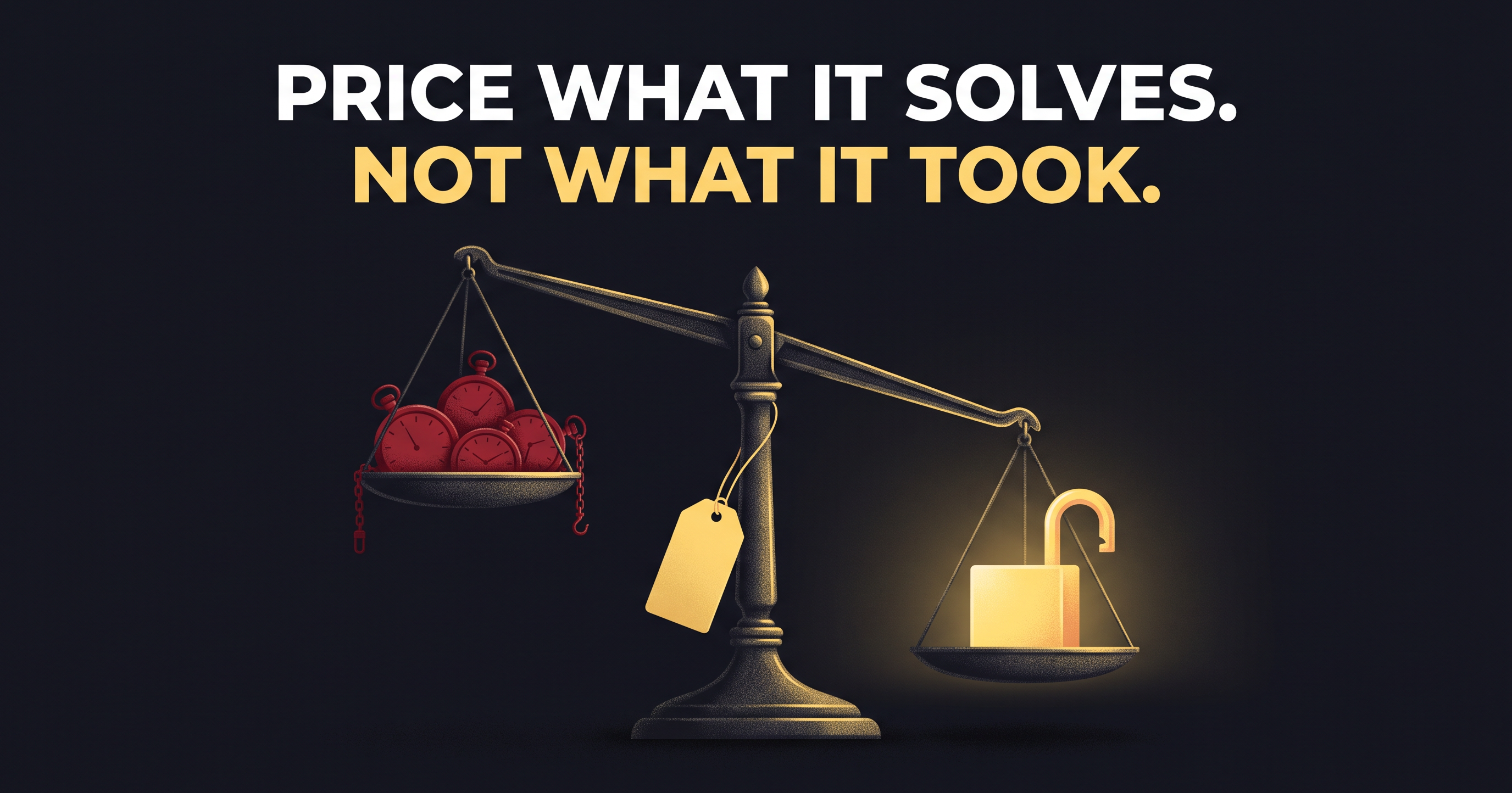
Most first products get priced by the hours. You count the time it took, put a number on that time, and call it a price. Or you look at what someone else charges and go a bit under. Both feel sensible. Both start from the one side of the table the buyer can't see.
This is a four-step way to price a digital product from the buyer's side instead. You finish with one price you can defend in a single sentence, and a reason behind it that has nothing to do with how long it took you.
Why most first prices come out wrong
Every product has three numbers sitting behind it.
- The hours. What it took you to make. It's real, and it's your cost. The buyer never sees it.
- The market. What other people charge. That's someone else's guess, and they probably guessed from their hours too.
- The problem. What it costs the buyer to stay stuck. This is the only number they actually feel.
Two of those numbers are about you. Only one is about them. Most pricing advice, and almost every pricing calculator, starts with the first two. Hours, costs, a margin, a competitor check. None of them ask what the problem is costing the person you're selling to.
Your hours are your cost. Their problem is your price.
Step 01: The problem — name it in their words
Not what your product is. What it fixes.
“A checklist” is what it is. “I don’t know where to start” is what it fixes. Nobody wakes up wanting a checklist. Plenty of people wake up not knowing where to start.
You already have their words. A DM someone sent you. A line from a client call. A reply to an email. The question you’ve answered ten times. Lift the sentence exactly as they said it.
The test: could they have said this sentence themselves? If it has your jargon in it, it’s your words. Rewrite it until it sounds like them.
This step matters for price because you can’t price a checklist. Checklists are worth nothing on their own. You can price “I don’t know where to start”, because that is costing somebody something.
Step 02: The cost — what it costs them, per month, unsolved
Now put a number on what that problem costs while it stays unsolved. Count it per month, in whatever unit fits:
- Money spent on tools or courses that didn’t fix it.
- Time lost every week going round in circles.
- Missed sales that didn’t happen because the thing wasn’t working.
- The wrong build: months spent on something that never needed building.
Use their numbers, not yours. A rough figure they’d recognise beats a precise one they’d argue with.
The test: if you asked them what this is costing, would they nod at your number? If not, you’ve made it up. Go and ask someone.
This is the step almost everybody skips, and it’s the only one that tells you what the product is worth.
Step 03: The slice — charge a small slice of their cost
Your price is a small slice of what the problem costs them. Not a fraction of your hours.
When the problem costs someone a few hundred pounds a month and your price is a small slice of that, the decision makes itself. They’re not weighing up your time. They’re comparing your price against the thing they’re already losing.
How big a slice? Small enough that the yes feels obvious. If you have to argue for it, either the slice is too big or step two was too vague. Go back to step two before you touch the number.
The trap: price it by your hours and you weld it straight back to your hours. You’ve made something once and put a wage on it, so every sale feels like being paid for a day’s work. It isn’t a day’s work. It’s an asset. Price it like one.
Step 04: The sale — sell it three times at that number
Pick three people who have already asked you about this problem. Same price for all three. No discount, no “special price for you”. Send them the page, not a pitch. A pitch is you leaning on the price. The page is the price standing on its own.
Then read the answer:
- All three say yes, no questions: raise it. If nobody hesitates, you’re not cheap. You’re early.
- One or two say yes: hold it. That’s a real price.
- Nobody says yes: don’t touch the price yet. Go back to step two. Nine times out of ten, the problem wasn’t the one they actually have, or the cost wasn’t one they feel.
Change the price on evidence, never on nerves.
Your price, in one sentence
Put the four steps together and you get one line:
It solves _. That costs them _. I charge ___.
The third blank is a number. Not “it depends”, not “from”, not “around”.
A worked example: “It solves ‘I don’t know what to post’. That costs them five hours a week and a month without an enquiry. I charge £19.” The price is a small slice of the cost. The hours it took to write never came into it.
If you write yours and the third number looks tiny next to the second, you’ve just found out you’re underpriced, and you found it out from their side of the table.
I ran this on my own front door. The question people ask me most is “how do I start marketing online?”, and the most common version of it is “help me build a website, I’m behind on it”. What that costs them is months building a website with no strategy behind it. I know, because that was me. So the price is set against that cost, not against how many pages it runs to.
Value-based pricing, without the jargon
If you’ve searched for pricing advice you’ll have hit the phrase value-based pricing. Most explanations are written for consultancies and software companies, with customer-value models and willingness-to-pay surveys.
For a first digital product you don’t need any of that. Value-based pricing is simply the Problem Price with the jargon taken out:
- Value is what the problem costs them (step two).
- Pricing is the slice you charge of that (step three).
- Based means the number comes from their side, not yours.
The difference between that and cost-plus or hourly pricing isn’t the maths. It’s where you start looking. Cost-plus starts with you. Value-based starts with them.
Three reasons first prices come out low
Each of these feels like strategy. None of them are.
- Cheap: “Low means more buyers.” People don’t buy cheap. They buy solved. If it doesn’t fix the thing, a low price won’t save it.
- Fair: “It only took me a day.” The day is your cost. Their problem doesn’t get smaller because you were quick.
- Later: “I’ll raise it once it’s proven.” A low price proves the wrong thing. If it sells at £9, all you’ve learned is that it sells at £9.
All three price you. None of them price the problem.
An hourly price is a wage in disguise
This isn’t just a sales tactic. It’s structural.
A wage is priced by the hour, capped by your calendar, and ends when you stop. An asset is priced by the problem it solves, capped only by how many people have that problem, and keeps selling when you stop.
The price is where you decide which one you’ve built. Price by the problem and the value stays locked into the asset. Price by the hour and the value leaks straight back to your time. That’s Asset Anchoring, one of the four parts of the SOI™ Framework, applied to a single number.
If the funnel disappeared tomorrow, what do you still own? A product priced on what it solves keeps its value on its own.
Price what it solves, not what it took.


