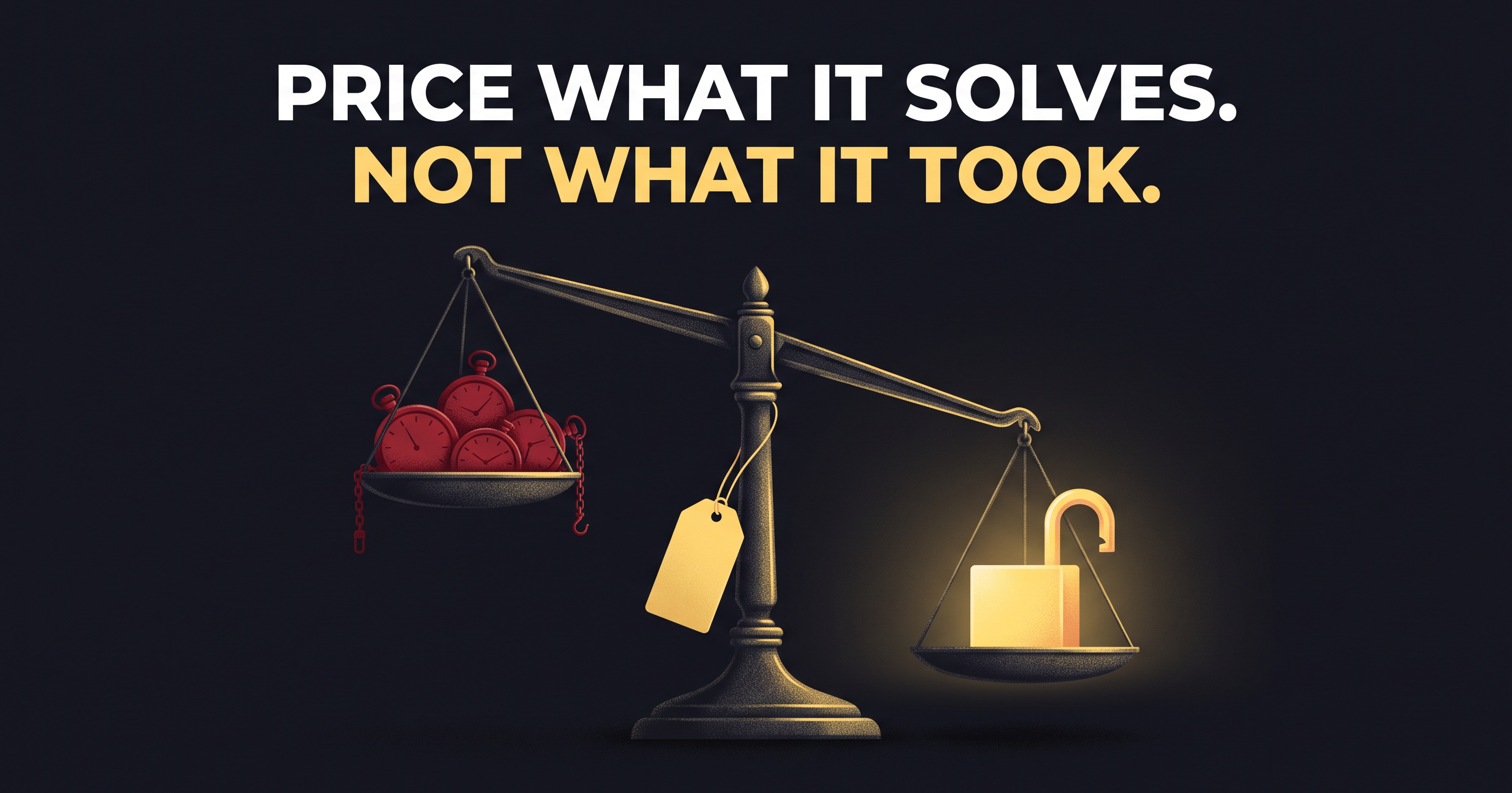
You made a sale. Then the sale needed you. You sent the file, explained how it works and answered the same email three times. The money came in, but so did the work.
That isn't a product. It's a booking with extra steps. Every pound still goes through you, so every pound is still your time. This post shows you where you're still in the room, and how to take yourself out of one part of it this week.
Automation isn't a tool problem
Most people treat "run without you" as a software question: which automation app, which course platform, which plan.
It isn't. It's a presence question.
You probably have the tools already. The gap is somewhere else. There's a link you still send by hand, a "DM me for the price", or a welcome message you type out every time. Each one is a moment that waits for you, and each one caps the business at your calendar.
You don't need more automation. You need one moment that no longer needs you.
The three hand-offs
Every sale passes through three moments. Each has one question:
Did it need me in the room?
01. The delivery
They paid. Do they get it without you?
If the honest answer involves you checking your notifications, you're in the room. The customer has paid and is now waiting on your attention.
The install: payment triggers access. The file, the course or the members' area unlocks automatically the moment money lands. There's no "I'll email it over" and no adding people by hand.
The test: buy your own product. If you have to do anything after the payment clears, that's the gap.
02. The sale
Can they pay without talking to you?
"DM me for the price" means you're standing at the till. So is "book a call" for something under a hundred pounds, and so is sending an invoice by hand. Each one needs you present before anyone can pay.
The install: one page, one price, one checkout. The button takes money. Nobody has to wait for you to reply.
If you've read the Subtraction Pass, this is where that single page ends: one offer, one CTA, and a checkout that works at 3am.
03. The support
Their first question. Is the answer already there?
Every buyer asks the same first question. How do I log in? Where do I start? What if I get stuck? If you're typing that answer out by hand, you're in the room.
The install: write the answer once and put it where they'll ask. That's the welcome email, plus a short FAQ inside the product itself. Put the answer where they are when they ask, not where it's convenient for you.
The rule: hand off one, in order
This is where most attempts fail. People try to hand off all three at once, finish none of them, and stay in three rooms instead of one.
Hand off one, in this order:
- Delivery first. If you automate the sale while delivery still needs you, you've built a faster way to book your own time. More sales means more of you.
- Then the sale. Once delivery runs itself, remove the conversation standing between interest and payment.
- Then the support. It's the one you can keep doing by hand the longest, because a buyer asking a question has already paid and already received.
One hand-off makes the first pound that isn't your time. Three make it a system.
Why you're still in the room
Three beliefs keep people there. They all feel like progress.
- "I'll automate everything at once." Three half-finished hand-offs still leave you in three rooms.
- "I need the right software first." Software doesn't take you out of the room. A decision does.
- "I'll hand it off when it's bigger." Bigger means more of you, in more rooms. The easiest time to hand off is at one sale.
None of them take you out of the room.
A worked example
This week I ran this on a £47 guide I sell.
- Delivery: handed off. Paying unlocks it inside my hub, and nothing gets emailed by hand.
- Sale: handed off. It has one checkout, and I ran a test purchase myself to prove it works without me.
- Support: this week's hand-off. I'm writing the first questions buyers ask, answered once, into an FAQ inside the guide and into the welcome email.
Sales so far: zero, because I haven't sent the email that tells people it exists. That's a different break, and I'm fixing it next. The structure is ready for the sale when it comes, and it won't need me to be there.
How to automate your business processes (without buying anything)
When people search for how to automate their business, they usually get a list of tools. The tools aren't the hard part. The order is.
Run each process you have through the same question: did it need me in the room? Start at the process closest to the money, which is delivery. The one change that matters is replacing "I do it when I see it" with "it happens when they pay."
Most platforms you already use can do this: a payment trigger, an access rule and a saved email. Get that one working and tested before you touch anything else.
In the room vs out of it
Here's why this matters structurally.
In the room → Priced by the hour | Capped by your calendar | Stops when you stop
Handed off → Runs on a trigger | Capped by demand | Keeps running when you don't
The SOI™ Framework runs on one chain: Control → Clarity → Consistency → Compounding → Freedom. A hand-off is the point where consistency stops depending on your calendar. Nothing compounds while it still needs you to turn up.
This isn't about more tools. It's about better architecture.
And the Litmus Test still applies: "If the funnel disappeared tomorrow, what do you still own?" After this week, part of your answer should be the moments that run without you.
Your sentence
Finish this, and put a real day in the second blank. Not "soon".
The hand-off I make this week is _. By _, it won't need me.
If the sale needs you, it's not a product. It's an appointment. A product is anything that sells while you're somewhere else.