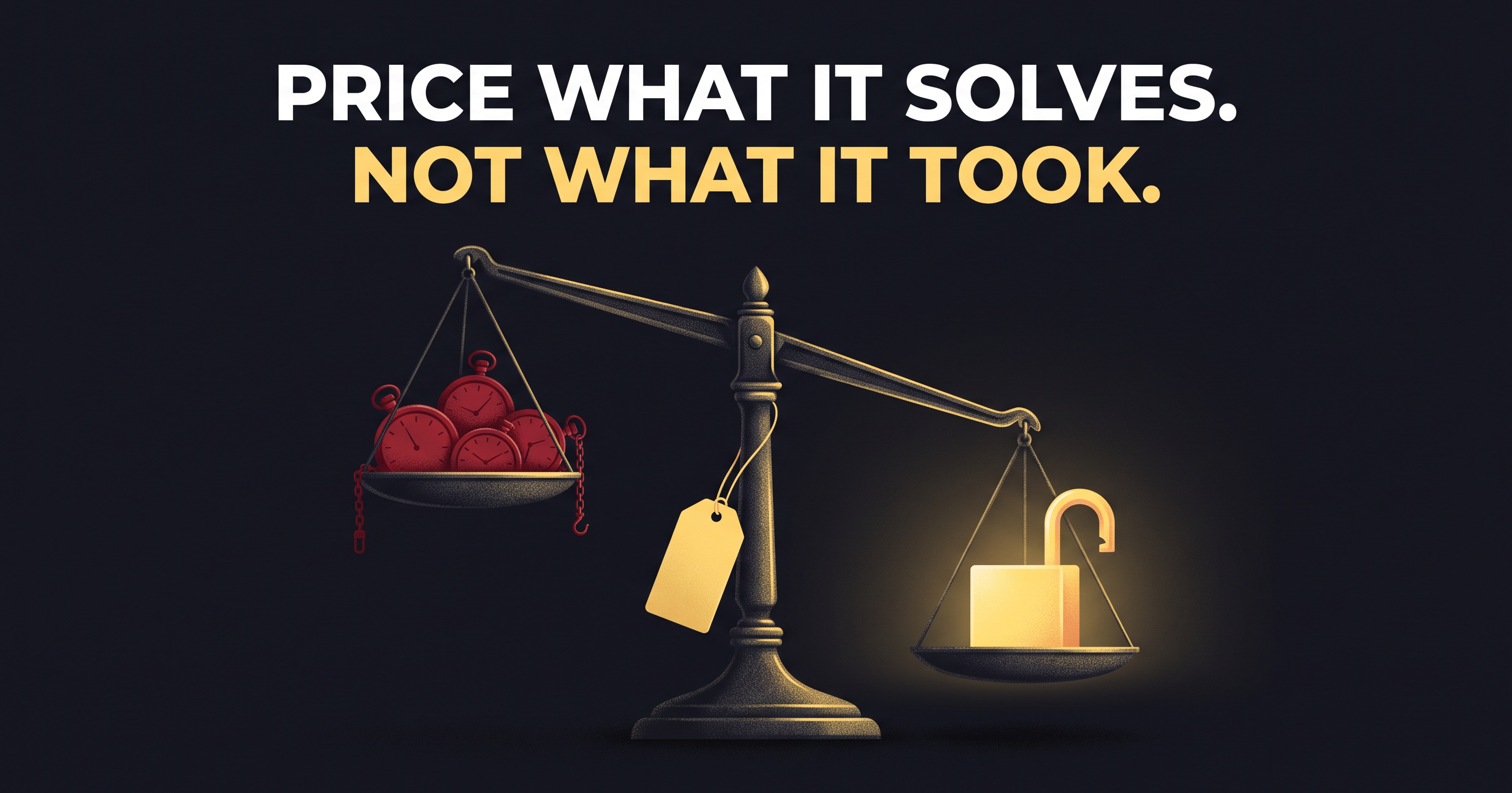
It is 9pm on a Tuesday. You open the app and it tells you the account has been disabled. No email. No warning. No explanation you can do anything with.
Most people have thought about this moment. What they have thought about is the appeal — and the appeal is the least useful part of the whole sequence.
Here is what actually happens instead, phase by phase, and the four things you install beforehand that change the answer at each one.
A ban is not an event. It is a reveal.
Look at what a ban can and cannot touch.
It cannot touch your email list. That is a file. It cannot touch your domain — you are the registrant, and the platform is not a party to that agreement. It cannot touch your customer records, your invoices, or the actual files your work is made of.
What it removes is everything you were renting.
So the morning after, whatever is still standing is your business. Everything else was borrowed momentum that you had started to mistake for an asset.
That is not a comforting thought. For a lot of people that number is close to zero. But it is a measurable one, and you can measure it tonight without anybody banning anything.
What survives, and what does not
Goes dark with the account: your followers, your DM history, your comment threads, the traffic routed through your bio link, and every hour of reach you earned.
Still yours the next morning: your email list, your domain, your site and the search equity attached to it, your customer records, and your content masters.
Now the useful question. Look at those two lists and work out which one your business is currently standing on.
The Blackout Drill
Four phases on the clock. You run it on a quiet night so you are never learning it on a loud one.
Phase 01 — Hour one: the silence
What actually happens is silence. You do not get a phone call. You do not get an explanation detailed enough to act on. You refresh, and the app has changed its mind about you.
And most people focus on the wrong loss here. They think: I cannot post. You were not going to post tonight anyway.
The real loss in hour one is that you cannot message. Every conversation running through that inbox stopped mid-sentence — from the other person's side as well as yours. They do not know you were banned. They know you went quiet.
The install: one channel to your people that does not live inside the account. An email list is the obvious one. But be honest about the bar: a phone number in a spreadsheet counts. The test is not whether it is sophisticated. The test is whether it still works when the account does not.
Phase 02 — Day one: the appeal
An appeal is a form, a queue, and an automated first pass. You cannot escalate it. You cannot add context. And critically, nobody will tell you how long it takes, which means you cannot plan around it. You cannot tell a client you will be back Thursday, because you genuinely do not know.
Appeals sometimes work. Treat one as a ticket you are allowed to buy, not a plan you are allowed to rely on.
The install: proof of who you are, kept outside the account. The email address you originally signed up with — do you still have access to it? The recovery address. Your two-factor backup codes, which are useless sitting on the phone that is already logged in, because the whole point of them is the day you are locked out. Put them somewhere that is not that phone. This takes five minutes.
Phase 03 — Week one: the inventory
The adrenaline drops and you start counting. This is the week you learn the difference between what you lost and what you never had a copy of.
Your content is not lost if you hold the files. It is unpublished, which is annoying rather than fatal — you can put it anywhere. The things you never copied are a different category.
The install: an export you already ran. Every major platform has a download-your-data button. Go and find it in the settings; it is there. And here is the part worth sitting with: that button lives inside the account. An export you run after the ban is an export you cannot run. It is the smoke alarm you buy after the fire. Set a reminder, once a quarter, run it, drop the file in a folder. Twenty minutes a year.
Phase 04 — Month one: the redirect
A month out there are two versions of you.
Version A starts again at zero. New handle, and the strategy is to ask everyone to find them again — through the one channel they can no longer be found on. That is the trap: asking for help through the locked door.
Version B sends one email. The account went down, here is where I am now, nothing else changes. Same people, same offer, new address.
Version B did not handle the crisis better. Version B installed one thing, at some point, and then forgot about it.
The install: the list that turns starting over into moving house.
Can Instagram ban your account?
Yes — and so can every other platform you use, because you agreed they could when you signed up. That is not a scandal, it is the terms.
The more useful version of the question is not whether they can, but what it costs you when they do. Two people can lose the same account on the same day and be in completely different situations a month later, and the difference has nothing to do with who was treated more fairly. It is entirely down to which of the four installs above were already in place.
Which is why "can they?" is the wrong thing to research at 9pm on a Tuesday. By then the answer has stopped mattering.
Three things that feel like preparation, and are not
Warning. The assumption that you would see it coming — a strike, a notice, a grace period. Most account disables are automated and land the moment the system decides. There is no yellow card before the red one.
Appeal. The assumption that there is a person on the other end. At our size there is a form and a queue. That is not villainy, it is scale.
Backup. The sneaky one. "It is all on my phone anyway." Your photos are on your phone. Your captions are on your phone. Your people are not. The relationship lives on the account, and the account is the thing that went.
All three feel like preparation. None of them are.
The one number worth knowing
Under UK GDPR you have a legal right to a copy of your personal data — Article 20, the right to data portability — and the company has one month to respond to that request.
So your right to your data is real. It is law. It is just not fast. It is a formal request with a statutory clock on it, not a download button.
Which is precisely why you run the export while you still have the button.
Run it tonight
The whole drill in four lines:
- Hour one — one channel to your people that is not the account.
- Day one — proof of who you are, kept outside the account.
- Week one — an export you already ran.
- Month one — the list that turns starting over into moving house.
You do not need all four tonight. You need the one you are missing.
For most people reading this it is number one, and they already know it is. That is fine. Everybody's number one is number one.
So go and do the smallest possible version of it. Not the perfect version — the smallest one that would work at 9pm on a Tuesday.
Because platforms bring the attention, and that is genuinely valuable. But anything you do not own cannot compound. A ban is just the fastest possible demonstration of it.